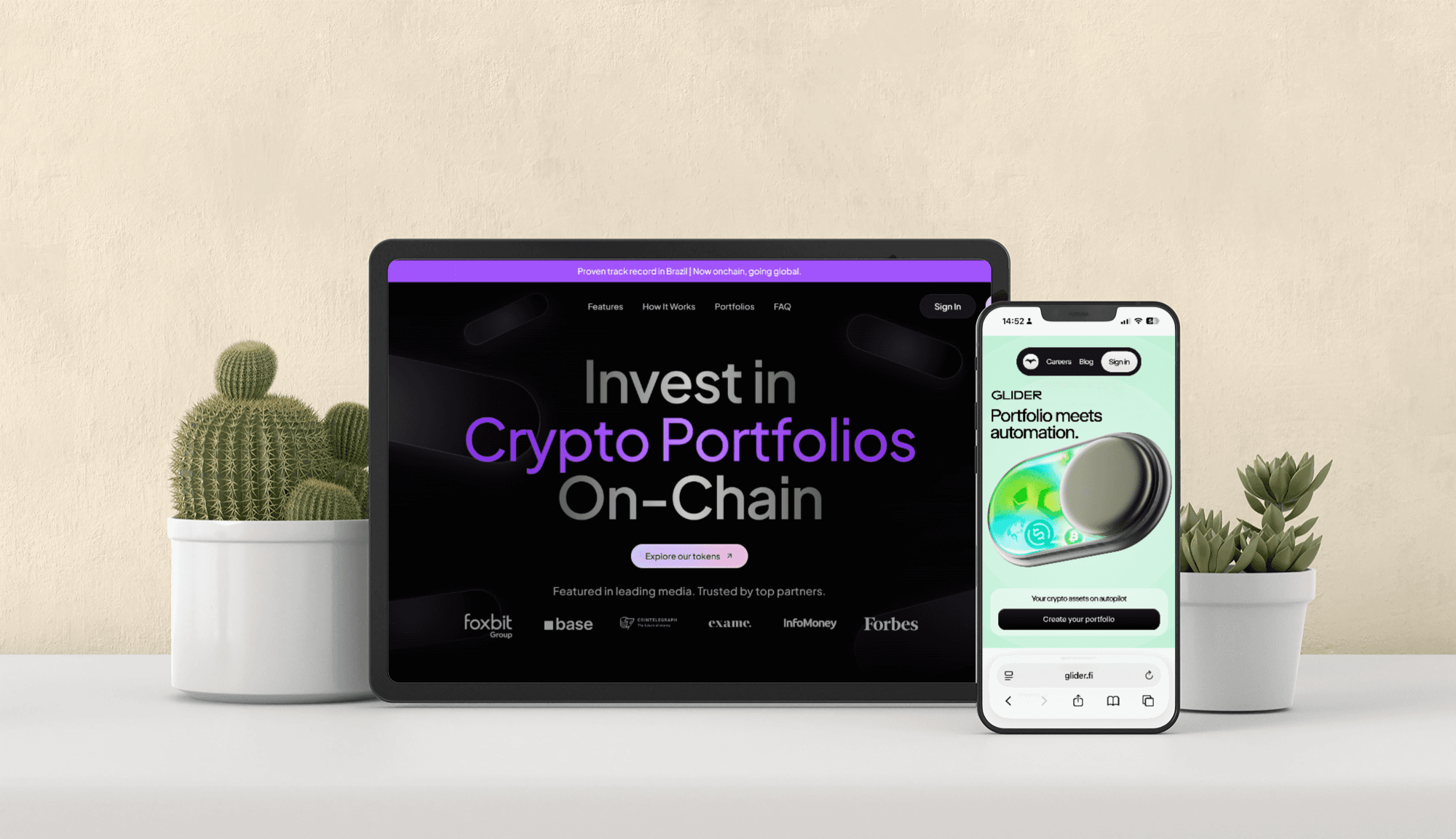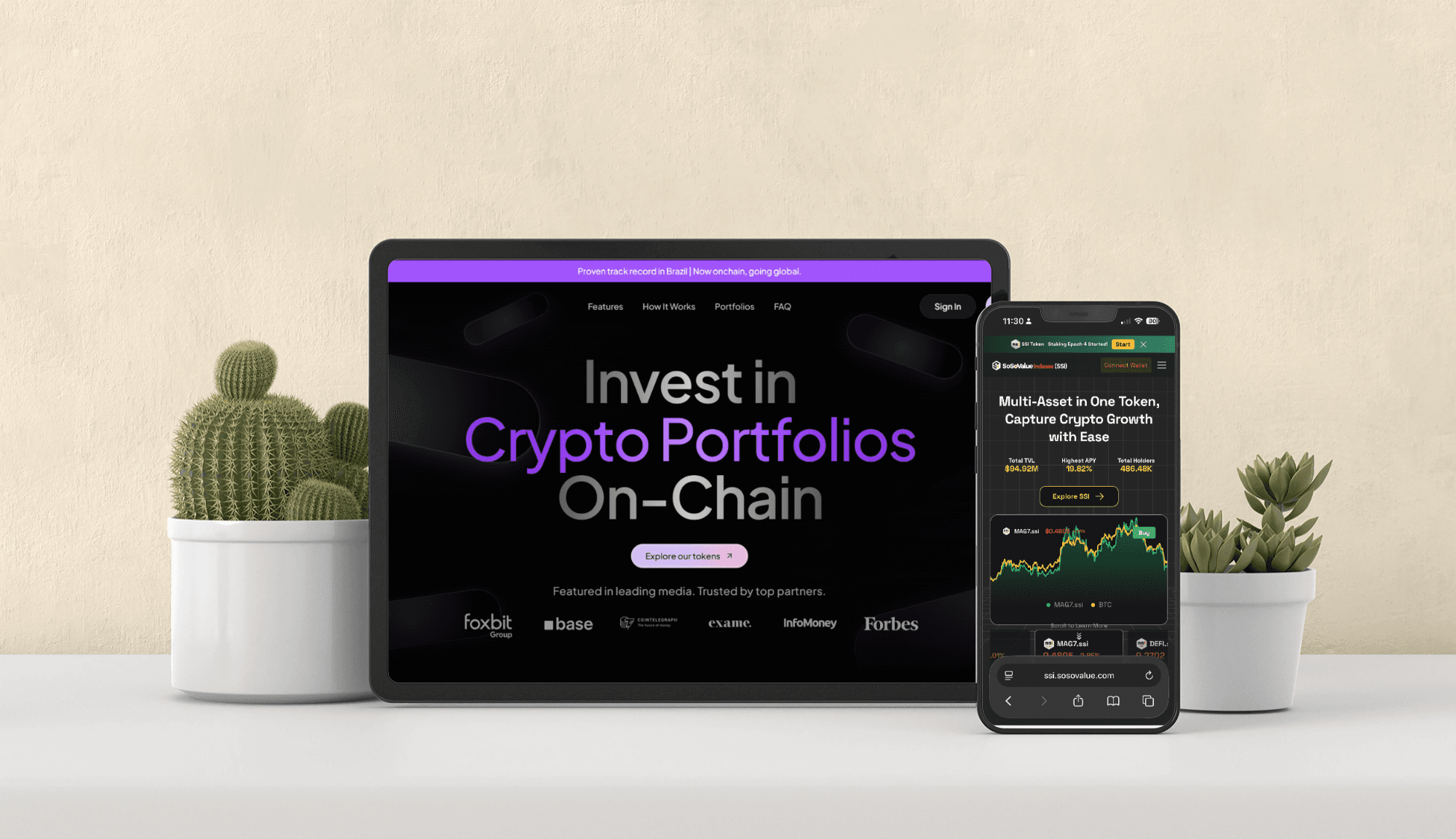
Both QINV Onchain and SSI Protocol offer diversified crypto exposure through tradable tokens on Base chain. The key difference lies in how each protocol stores the underlying assets, determines allocation, and who can mint or redeem tokens.
This article breaks down those differences with no fluff.
What are QINV Onchain and SSI Protocol?
Both platforms work as "tokenized crypto index funds": you buy a token that represents a diversified basket of crypto assets without having to manage each position individually. The core idea is similar; the execution is quite different.
QINV Onchain is an AI-managed portfolio protocol that issues QIndex (QINDEX), an ERC-20 token representing proportional ownership in an on-chain vault with automated monthly rebalancing. Assets are held directly by smart contracts on Base chain, and anyone can verify the balance in real time on a block explorer.
SSI Protocol (SoSoValue) issues four index tokens, MAG7.ssi, MEME.ssi, DEFI.ssi, and USSI, representing thematic crypto baskets. The underlying assets are custodied by Cobo and Ceffu (Binance's institutional arm), meaning they sit off-chain in third-party accounts.
Quick comparison: QINV vs SSI Protocol
| Dimension | QINV Onchain (QIndex) | SSI Protocol |
|---|---|---|
| Available token(s) | QINDEX (diversified portfolio) | MAG7.ssi, MEME.ssi, DEFI.ssi, USSI |
| Blockchain | Base (EVM) | Base (EVM) |
| Asset custody | On-chain (smart contract), verifiable anytime | Off-chain (Cobo + Ceffu), relies on third parties |
| Proof of reserves | Native (full on-chain transparency) | Not publicly available |
| Management fee | 5% per year (~0.0137%/day) | 3.65% per year (~0.01%/day) |
| Who can mint/redeem | Any user (via partner exchanges or directly) | Only verified WLPs (KYB required) |
| Retail access | Direct or via integrated exchange | Only via Uniswap (secondary market) |
| Allocation method | Quantitative AI (8 years of research, dynamic) | Pre-defined rules by market cap (static) |
| Rebalancing frequency | Monthly (on-chain signal) | Monthly |
| Audited contracts | Yes (independent pre-launch audit) | Yes (5\u20137 firms: SlowMist, BlockSec, Quantstamp\u2026) |
| Contract upgrades | Multisig + time-lock (controlled governance) | Upgradeable proxy with single admin key (Cobo) |
| DeFi composability | Yes (lending, LP, treasury, autonomous agents) | Limited |
| CEX integration | Yes (direct mint/burn model with exchanges) | No |
| Compatible with autonomous agents | Yes (deterministic endpoints + real-time NAV) | Not documented |
| Redemption lock-up | No | No |
| Current TVL | In fundraising (seed round) | ~$191 million (Feb 2025) |
Where are your assets? The custody debate
This is the most important difference between the two protocols, and likely the one that matters most for user security.
QINV Onchain: smart contract custody
With QINV, the assets backing QIndex are held inside an on-chain vault controlled by smart contracts on Base chain. This means anyone can access the vault address on a block explorer (like BaseScan) and verify in real time how much BTC, ETH, or other assets are deposited. There's no trust in third parties: the rules for custody, minting, and redemption are enforced by the code itself.
SSI Protocol: Cobo and Ceffu custody
SSI uses a CeDeFi model (centralized + DeFi). The assets backing SSI tokens are held in institutional accounts at Cobo (Singapore) and Ceffu (Binance's custody arm). The SSI token on the blockchain is real and transferable, but the underlying assets sit off-chain. There is no public proof-of-reserves mechanism, users trust that Cobo and Ceffu maintain the backing without being able to verify it directly.
What this means in practice: in a stress scenario, if Cobo or Ceffu faces regulatory issues, liquidity problems, or security breaches, the ability to redeem SSI tokens could be compromised. With QINV's on-chain vault, smart contracts determine redemption, regardless of any third party.
How does allocation work in each protocol?
QINV: dynamic allocation via quantitative AI
QINV's allocation engine combines eight years of quantitative research with machine learning. The portfolio doesn't simply follow asset market caps; it considers volatility, correlations, momentum, on-chain signals, and risk metrics to generate optimized weights monthly. The goal is to systematically build portfolios under risk constraints, not to maximize returns at any cost.
This means that in different market regimes, the QIndex composition can adapt, reducing concentration in excessively volatile assets or increasing exposure to assets with better risk-return profiles for the period.
SSI Protocol: pre-defined rules by market cap
SSI uses methodologies based on circulating market cap, with some variations. MAG7.ssi, for example, applies 10% equal weight across the top 7 assets and fills the rest with market-cap weighting. The methodology is public and straightforward, which has advantages in terms of predictability, but limits adaptability. The index doesn't respond to changes in market regime; it simply follows capitalization.
QINV Onchain:
- Quantitative AI (8 years of data)
- Signals: volatility, momentum, correlation, on-chain
- Concentration and drawdown limits
- Adaptive monthly rebalancing
- 5% per year management fee (~0.0137%/day), accrued on-chain
SSI Protocol:
- Market-cap-based methodology
- 4 thematic indexes (MAG7, MEME, DEFI, USSI)
- Transparent and predictable rules
- Monthly rebalancing with mint/burn pause
- 3.65% per year management fee (~0.01%/day), accrued daily
Management fees: paying for what you get
Both protocols charge a daily management fee that accrues proportionally over time. The mechanism is the same; the amount is not.
SSI charges approximately 0.01% per day, totaling 3.65% per year. QINV charges approximately 0.0137% per day, totaling 5% per year. That difference of 1.35 percentage points per year is the direct price of active management.
With SSI, the fee pays for maintaining a static index: assets are weighted by market cap, the methodology is pre-defined, and rebalancing follows a fixed rule. No research needed, no optimization engine running in the background.
With QINV, the same daily fee structure finances a quantitative system built over eight years of research. The portfolio weights are recalculated monthly using volatility signals, inter-asset correlations, momentum indicators, and on-chain data. The goal is not to replicate the market but to deliver better risk-adjusted returns over time. That kind of infrastructure has a cost, and the fee reflects it.
It is worth noting that both fees are fully transparent and verifiable on-chain. There are no hidden spreads on minting or redemption, no performance fees layered on top.
Contract security and governance
SSI Protocol has undergone multiple audits by recognized firms such as SlowMist, BlockSec, Quantstamp, and Zellic, a level of coverage above average in the DeFi ecosystem. The contracts are open-source and the reports are publicly available.
However, there's a point of concern: SSI's contracts use the upgradeable proxy standard (EIP-1967), and the admin address is controlled by a single Cobo key, with no visible on-chain multisig or timelock. This means that, in theory, the contract logic can be changed without approval from SOSO token holders. Decentralized governance is on the roadmap but has not been implemented yet.
QINV uses multisig and time-delay controls for parameter and contract upgrades, which distributes control and reduces the risk of a single compromised key altering the protocol without notice. Additionally, the on-chain vault eliminates the third-party custody risk present in the SSI model.
QINV vs SSI: pros and cons summary
| Criterion | QINV Onchain | SSI Protocol |
|---|---|---|
| Reserve transparency | Full (on-chain) | Not available |
| Self-custody model | Smart contract | Cobo / Ceffu |
| Adaptive quantitative AI | Yes | Static rules |
| Management fee | 5% p.a. (active AI management) | 3.65% p.a. (passive index) |
| CEX integration | Yes | No |
| DeFi composability | Yes | Limited |
| Index variety | QIndex (single, versatile) | 4 thematic indexes |
| Current TVL and liquidity | Under construction | ~$191M |
| Live protocol | Launching soon | Yes (since Dec 2024) |
| Contract audits | Yes | Yes (5\u20137 firms) |
| Multisig governance | Yes | Single admin key |
| Compatible with autonomous agents | Yes | Not documented |
Which investor profile does each protocol suit?
Choose QINV Onchain if you want your assets secured by code, not third parties; if you value dynamic, data-driven allocation over a static market-cap index; or if you plan to use the token in DeFi strategies (collateral, LP, treasury).
Choose SSI Protocol if you want immediate access to a live product with established liquidity on Uniswap; if you prefer specific thematic exposure (meme coins only, DeFi only); or if you're comfortable with off-chain custody and market-cap methodology.
Conclusion
SSI Protocol has proven that real demand exists for crypto index tokens, $191 million in TVL within a few months is evidence enough. But the CeDeFi model (off-chain custody, centralized admin key, 3.65% p.a. fee) presents trade-offs that sophisticated users and DeFi protocols tend to avoid.
QINV Onchain solves these problems at the root: smart contract custody, verifiable NAV, distributed governance, and allocation that learns from the market. For those seeking the crypto portfolio layer of Web3, and not just another index token, QINV was built to be that infrastructure.
This article is for informational and comparative purposes only and does not constitute investment advice. Crypto assets are high-risk investments subject to extreme volatility. DeFi protocol investments involve additional risks, including smart contract vulnerabilities, liquidity risk, and regulatory uncertainty. Data about SSI Protocol was sourced from publicly available information as of February 2025 and may have been updated since. Always consult a qualified financial professional before making investment decisions.
Sources: (1) QINV Onchain Whitepaper (2025) \u00b7 (2) SoSoValue SSI Protocol Documentation \u00b7 (3) BaseScan on-chain data \u00b7 (4) Uniswap V3 analytics (Base chain) \u00b7 (5) CoinGecko GoPlus Security Scanner \u00b7 (6) SSI Protocol GitBook